The Future of KYC in India: How Business Correspondents Are Enabling Faster and More Secure Customer Verification

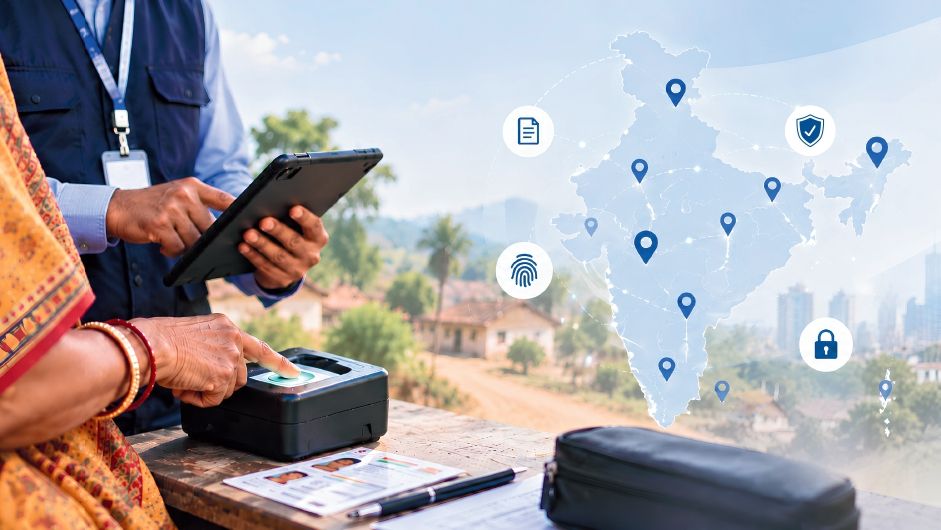
KYC has been mandatory in India since 2002. And for years, it largely meant customers visiting a bank branch, submitting documents, and completing the long verification checks. But over time, India's KYC ecosystem has evolved beyond traditional verification and moved to digital e-KYC, Aadhaar-based KYC, and other technology-led processes, changing how financial institutions verify customers and simplify onboarding.
However, in a country like India, with a vast population, diverse landscapes, and underserved regions, technology alone cannot bridge the last-mile gap. This is where Business Correspondents for KYC become an integral part of the process. When digital tools are combined with on-ground assistance, i.e., Business Correspondents, financial institutions bring KYC verification closer to every customer.
How Has KYC in India Evolved and Why Does Last-Mile KYC Still Matter?
Ever since KYC became mandatory in India, it has evolved significantly. The verification process that started as submitting physical documents and visiting bank branches was revolutionized by easy, less time-consuming Aadhaar and UIDAI e-KYC APIs and has now become super convenient with no-physical-visit video-KYC. But KYC is not just about verifying customers faster but making banking accessible to more people.
In India, where nearly two-thirds of the population lives in rural and underserved areas, even after KYC has gone digital, this transformation has not removed the challenges of last-mile banking, and the country's major population still faces gaps in digital access, documentation, or support. However, to make banking accessible in remote areas and close the digital access gaps, last-mile KYC is enabling financial institutions to take customer onboarding, KYC verification, and banking solutions closer to these customers. Through assisted KYC and the Business Correspondent model in India, the BC agents are bridging the gap between digital capabilities and on-ground needs, helping banks strengthen financial inclusion.
Role of a Business Correspondent in KYC and How They Make It Faster?
A Business Correspondent in banking is an important link between financial institutions and customers, particularly for people who have limited bank branch access. For elderly customers, people with limited mobility, or those less comfortable with digital processes, a BC agent brings banking and KYC verification closer to their doorstep.
Using mobile applications, biometric authentication, Aadhaar-based KYC, and real-time data capture, BC agents support document collection and verification without requiring the customer to make repeated branch visits. This makes customer onboarding more convenient, less time-consuming, and reduces manual effort for both customers and financial institutions. A strong BC network is thus making Business Correspondent KYC faster and more accessible, combining digital capabilities with human assistance to strengthen last-mile banking and financial inclusion.
How Digital Capabilities Are Making BC-Led KYC More Secure
When Business Correspondents for KYC expand across the last mile, technology becomes critical, ensuring that convenience for customers does not cost security. The digital platforms enable biometric KYC, easy document capture, identity validation, and real-time data transmission, thus reducing dependence on manual processes and minimizing errors.
Strong digital capabilities also strengthen KYC fraud prevention in various ways, like automated document checks, geo-tagging, time-stamped records, and controlled workflows that create a clear audit trail for every verification. Secure authentication mechanisms help ensure that customer information is captured and submitted through authorized channels, while system-based validations can flag inconsistencies for further review.
This combination of technology and human assistance is helping financial institutions enable secure KYC verification without compromising on accessibility. Thus, a BC-led customer verification results in a more controlled, traceable, and reliable process, supporting both KYC compliance and customer trust.
Business Correspondents Are Shaping the Future of KYC in India
The future of KYC in India depends on how effectively financial institutions make technology reach every customer. In a time when digital KYC, biometric KYC, AI-led validation, and real-time verification continue to advance, Business Correspondents bring digital capabilities and human assistance together and help financial institutions reach customers till the last mile.
For financial institutions, a strong BC network can mean faster customer verification, smoother onboarding, stronger KYC fraud prevention, and more accessible banking services for underserved communities. The evolution of Business Correspondent KYC therefore goes beyond convenience and represents a shift towards a more connected, secure, and inclusive banking ecosystem.
As India’s banking landscape continues to become more digital, BCs will remain an important part of ensuring that the benefits of this transformation reach every customer, wherever they are.
At Manipal Business Solutions, our technology-enabled field network supports doorstep KYC, biometric KYC, and assisted customer onboarding, helping financial institutions extend secure verification beyond traditional banking touchpoints. To explore how our solutions can support your business needs, connect with our team.